

Blogs & News
The California FAIR Plan: A Homeowner’s Guide to Fire Insurance in High Risk Areas
By Kelly Berkompas
The California FAIR Plan is the state’s insurer of last resort, and it is carrying more of California than at any point in its history. As of June 2026 it held 696,562 policies covering $768 billion in exposure, a 157 percent rise in policy count and a 250 percent rise in exposure since September 2022. If your carrier has non-renewed you, or every quote comes back declined, this is where you are likely to land. That shift has reshaped California home insurance in high fire risk areas for everyone, whether they are on the plan or trying to stay off it. This guide covers what the plan is, what California FAIR Plan cost looks like in practice, why fire risk zones drive the number, and which home hardening steps insurers will actually pay you for.
What the California FAIR Plan Is and Who Needs It
The plan describes itself as “an insurer of last resort, established by statute to provide basic property insurance to Californians statewide when no other option is reasonably available.” It is not a state agency and it is not funded by taxpayers. It is a shared pool that property insurers licensed in California participate in, which is why losses beyond what premiums cover get assessed back to those member companies rather than to the state. The plan exists so that property owners are not left with nothing when the private market will not quote.
Eligibility turns on a single test: comprehensive coverage is not available in the traditional marketplace. Your broker has to run a diligent search for standard coverage first, and only when that search comes up empty does the FAIR Plan become an option. Nobody picks it as a preference. Homeowners arrive there after a non-renewal, after a carrier withdraws from their county, or after buying a house in a zone no admitted insurer will write.
Policy limits are capped. A dwelling fire policy tops out at $3 million. Commercial policies are limited to $20 million per building, within a $100 million limit per location across a three-year program. Above those ceilings, owners of higher value property have to layer surplus lines coverage on top.
What California FAIR Plan Fire Insurance Actually Covers
California FAIR Plan fire insurance is deliberately narrow. The dwelling policy is a named peril policy, which means it pays only for damage caused by the perils written into it: fire, lightning, internal explosion and smoke. Vandalism and malicious mischief can be bolted on for extra premium.
What it leaves out is most of what a standard homeowners policy bundles in. There is no liability cover, no theft cover, no burst pipe, no falling tree. The plan itself points policyholders toward a Difference in Conditions policy, bought separately from a private carrier and stacked on top, to fill those gaps.
Homeowners insurance in a California high fire area usually means two policies and two bills: California FAIR Plan fire insurance handling the fire peril, and a DIC policy handling everything else. Any comparison that stops at the fire premium understates what you are really paying. If you are weighing what a standard policy would and would not pay for, our guide to whether homeowners insurance covers wildfires works through the detail.


California FAIR Plan Cost: What Homeowners Are Paying
There is no single answer to California FAIR Plan cost, because pricing runs at ZIP code level and the spread is enormous. An analysis of plan data current to September 2025 put the average homeowner premium at just over $3,000 a year, with individual policies ranging from $92 to around $32,000. One high risk property in south San Jose came in just under $31,900. Landlord policies averaged just under $2,000 statewide, renters $466, and condominium owners $496.
Across the book, total written premium reached $2.04 billion by June 2026, up 212 percent since September 2022. Two pressures point it higher from here.
The first is rate filings. In September 2025 the plan filed for a 35.8 percent increase against an indicated rate need of 80 percent, and that filing was still pending when the plan’s president presented to the Assembly Insurance Committee in January 2026. For context, a 48.8 percent filing made in 2021 was approved at 15.7 percent two years later, so the approved figure tends to land well below the ask. Either way, the direction of travel for California FAIR Plan cost is upward.
The second is catastrophe exposure. After the Eaton and Palisades fires the plan handled around 5,400 claims and paid roughly $3.5 billion to policyholders, then levied a $1 billion assessment on member insurers in February 2025. The scale of that is easier to grasp against history: the previous assessments were $150 million in 1993, $60 million in 1994 and $50 million in 1995. Neither pressure is inside a homeowner’s control. The discount side is, and hardening items like fire-rated vents are the part you can act on before your next renewal.
How Fire Risk Zones Set California Home Insurance in High Fire Risk Areas
Premiums are not priced off your address in any loose sense. They are priced off how the mapping and modeling behind your address scores. Three systems now set California home insurance in high fire risk areas, and all three are worth understanding before you challenge a quote.
First are CAL FIRE’s Fire Hazard Severity Zone maps, which grade land as Moderate, High or Very High. Updated State Responsibility Area maps took effect on April 1, 2024, and updated Local Responsibility Area maps were released in four phases across February and March 2025. Plenty of homeowners are now inside a mapped zone who were not before, which is worth checking, because zone status carries building and defensible space obligations, and it feeds straight into California FAIR Plan cost as well as into what admitted carriers will quote. Our guide to fire hazard zones explains how to look yours up.
Second is the wildfire risk score your insurer assigns you. Under the Department of Insurance’s Safer from Wildfires regulation, carriers must give you that score when you apply, before a renewal or non-renewal, and again once you have completed mitigation work. They must also explain how the score was reached, and they must offer discounts for the mitigation actions the regulation lists. That last obligation is the lever most homeowners never pull, and it is the single fastest way to move the price of homeowners insurance in a California high fire area. Ember-resistant vents are among the cheaper items that move it, which is why fire-rated soffit and eave vents are a common first upgrade.
Third is catastrophe modeling. Under the department’s Sustainable Insurance Strategy, insurers may now use forward-looking models in ratemaking, in exchange for a commitment to write at least 85 percent of properties in distressed areas. The intent is to move policies off the FAIR Plan and back into the admitted market, which makes a well documented mitigation record more valuable than it has ever been.


Reducing Your Premium: the Discounts You Can Actually Claim
This is the part homeowners control. Since August 23, 2023 the plan has offered published wildfire hardening discounts rather than discretionary ones. A dwelling policy can earn up to 16.4 percent off the wildfire portion of your California FAIR Plan fire insurance premium, and a commercial policy up to 13.8 percent. Ten qualifying actions sit behind that, split into two groups of five, and meeting all ten earns a further property level completion discount on top.
On the immediate surroundings, the plan credits clearing vegetation and debris from under decks, removing vegetation, mulch and combustibles within five feet of the dwelling, using only noncombustible materials for fences and gates inside that five feet, moving combustible sheds and outbuildings more than 30 feet away, and keeping trees trimmed and brush cleared in line with state and local defensible space rules.
On the structure itself, it credits a Class A fire rated roof, enclosed eaves, ember and fire resistant vents, multi-paned windows or functional shutters, and noncombustible material for the bottom six inches of exterior walls. Of those five, vents are the one you can retrofit on their own without touching the rest of the building, so ember-resistant under eave vents tend to be the quickest credit to claim. Every one of those items also appears in the Safer from Wildfires framework that admitted carriers work to, so the work counts twice: once on your California FAIR Plan premium now, and again when you try to move back to the private market. Our summary of California’s Safer from Wildfires standard walks through each layer.
A February 2025 executive order directed the Board of Forestry and Fire Protection to adopt “Zone 0” rules requiring an ember-resistant zone within five feet of structures in the highest fire severity zones. Draft rule text was still moving through public workshops during 2026, with new construction expected to comply on adoption and existing homes phased in over three years. Doing that work early earns the discount now and avoids the compliance scramble later. Zone 0 covers the first five feet, which puts foundation vents squarely in scope, because ground level is where wind-driven embers pile against a wall.
Why Vents Are the Item Most Homeowners Underestimate
Of the ten actions that bring California FAIR Plan cost down, ember-resistant vents are the one homeowners most often skip, and there is a solid body of research on why that is a mistake. Research by the Insurance Institute for Business and Home Safety describes wind-blown embers as the principal cause of building ignitions during wildfires and identifies attic vents as one of the most vulnerable points in a structure. Its testing found that vent type, configuration and orientation all significantly affect how much ember material gets inside.
The problem is structural rather than incidental. A vent has to stay open, because attics and crawl spaces need airflow to control heat and moisture. Standard mesh holds back leaves and rodents. It does not stop the fine, wind-driven ember shower that arrives well ahead of a fire front, and it does nothing at all about radiant heat or flames passing through the opening. That combination of permanent opening and ember exposure is why vents sit on the California FAIR Plan discount list at all. An exposed gable vent is among the simplest openings on a house to upgrade.
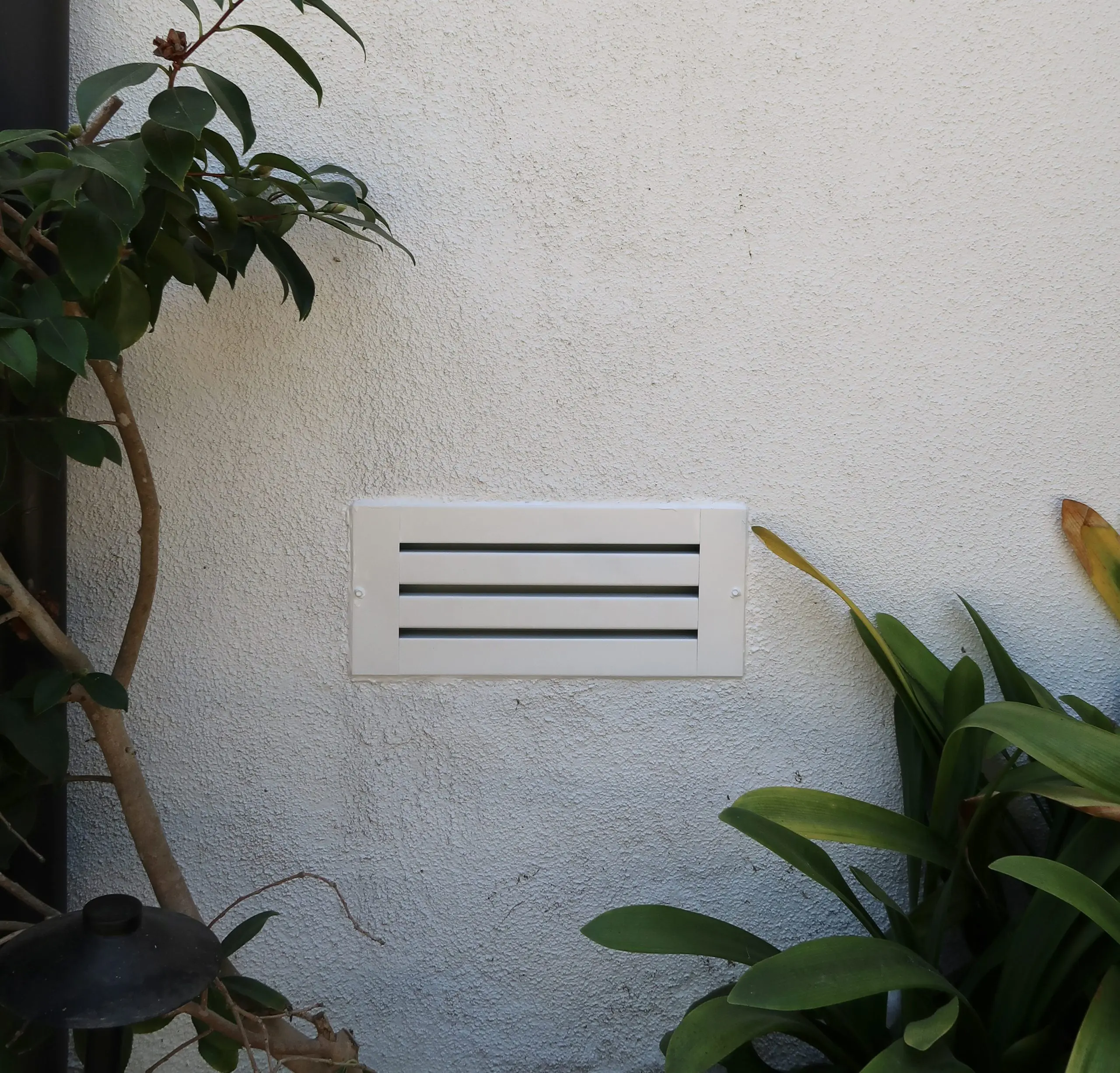
California’s building code accounts for this. Under Chapter 5 (previously 7A) of the California Building Code, ventilation openings for enclosed attics, soffit spaces, rafter spaces and underfloor areas have to be covered so they resist flame and ember intrusion. Corrosion-resistant noncombustible wire mesh is one route. A vent tested and listed by the California State Fire Marshal is the other, and local requirements in some jurisdictions go further than the state minimum, so check with your building department. Listing runs through ASTM E2886, which a vent passes only if there is no flaming ignition of the cotton material during the ember intrusion test, no flaming ignition during the integrity portion of the flame intrusion test, and the temperature on the unexposed side stays below 662 degrees Fahrenheit. Listed products are published in the State Fire Marshal’s WUI Listed Products Handbook. Be sure to check the orientation of the listing, some are only listed in a vertical application, and not horizontal.
BrandGuard vents are tested and listed to that standard, in both vertical and horizontal orientations. They combine overlapping baffles that keep air moving while trapping embers, a 1/16 inch noncombustible metal mesh behind the opening, and Tenmat intumescent strips that expand under extreme heat and seal the vent closed. That last layer is what mesh alone cannot do. Separately, NIST ran 16 full-scale fire tests on WUI-approved eave vents in June 2025 and found that intumescent baffle vents, the design BrandGuard uses, activated earlier, stayed closed longer and prevented flame penetration, while honeycomb vents let flame through once the eave ignited. NIST does not endorse products and BrandGuard units were not among those tested, but the findings on intumescent baffle vents speak to the design principle.
BrandGuard supplies several flange types for both new construction and retrofit, so existing openings can usually be upgraded without reworking the surrounding structure, and doing so addresses one of the ten California FAIR Plan discount criteria outright. Work through the rest of the building in the order embers reach it: dormer vents and sub-base roof vents on the upper roof, continuous vents along longer eave runs, and foundation vents at ground level, where embers collect against the wall and drift into the crawl space. Every opening you upgrade is one fewer item an underwriter can mark against you.

Firewise USA and the Community Discount
Some of the discount is out of your hands alone. The plan applies a community discount to dwellings located inside a Firewise USA site in good standing, or in a Fire Risk Reduction Community listed by the Board of Forestry. Neither is something you can arrange on your own, which is why it is worth raising with your neighbors.
Firewise USA is run by the National Fire Protection Association and is designed for neighborhoods rather than individual homes. A site needs between eight and 2,500 dwelling units, and recognition rests on five things: forming a board or committee of residents and local fire stakeholders, producing a written wildfire risk assessment with the local fire department, publishing an action plan of prioritized projects updated at least every three years, holding at least one wildfire risk reduction outreach event a year, and making an annual risk reduction investment equivalent to one volunteer hour per dwelling unit.
That investment requirement is where most people expect a barrier and find none. Sites are not required to spend cash. Volunteer labor, contractor costs, equipment rental, grant funding and the mitigation work individual homeowners do on their own property all count toward the total, and the whole thing renews annually. Once a site is recognized and in good standing, every dwelling inside it qualifies for the California FAIR Plan community discount.
The point worth holding onto is that a Firewise site is a group of hardened homes, not a plaque, and that group effort feeds into what everyone inside it pays for homeowners insurance in a California high fire area. The fact that the plan prices a community discount at all tells you insurers are looking at the neighborhood as well as the structure. Individual hardening still does the heavy lifting, and our account of what the Palisades and Eaton fires showed about how homes survive describes protected houses left standing while neighboring properties burned.
Getting Back Off the California FAIR Plan
California FAIR Plan fire insurance is meant to be temporary, and moving back to an admitted carrier is usually the cheaper outcome. Four steps make that realistic.
Document everything. Photograph each mitigation item as you complete it, keep invoices and product listings, and hold onto the State Fire Marshal listing numbers for any WUI-listed products you install. An underwriter cannot credit work they cannot verify. Multi-family owners have a second reason to keep the file, because balcony inspection vents satisfy SB 721 and SB 326 inspection access and the wildfire criteria on one spend.
Ask for your wildfire risk score, then ask again after the work is done. The Safer from Wildfires regulation entitles you to both, and to an explanation of what drove the number.
Consider an IBHS Wildfire Prepared Home designation. Available in California, Oregon, Colorado and many other western states exposed to WUI areas. It comes in a base level aimed at wind-driven embers and a Plus level covering direct flame contact and radiant heat, and it gives you a third-party verified record of your home’s condition. Ember-resistant vents and a noncombustible zone within five feet are both part of the standard.
Re-shop before every renewal. Admitted carriers are under pressure to write in distressed areas under the 85 percent commitment, so the market you were declined by two years ago is not the market you face today. Timing your mitigation work to land before a renewal quote is the difference between a discount this year and a discount next year, and re-shopping is how homeowners eventually get California home insurance in high fire risk areas back to a normal price.

GET PREPARED TODAY
Where to Start
If you are paying for California FAIR Plan fire insurance today, the sequence that brings the premium down fastest is the five foot zone around the house, then vents, then the roof and eaves as they come up for replacement. The first two are cheap relative to what they do, they are permanent, and they sit on both the FAIR Plan discount list and the Safer from Wildfires framework that private carriers use. Wildfire season timing matters too, so it is worth reading our guide to the California wildfire season before you schedule the work.
BrandGuard has been making State Fire Marshal listed vents for wildland urban interface homes for more than two decades, and works directly with homeowners, contractors and insurance brokers on home hardening specifications. To size and specify vents for your property, get in touch with our California team or browse the full product range.
Related Posts
-
The California FAIR Plan is the state’s insurer of last resort, and it is carrying more of California than at…
-
Independent third-party verification for both wildfire protection and one-hour fire-resistance-rated assemblies When specifying fire protection products, independent verification matters. It…
-
Crawl Space Vents: The Complete Guide to Ventilation and Moisture Control Crawl space vents are the openings set into your…
